- THE SOCIETY Newsletter
- Posts
- The SOCIETY #117

AUGUSTA NATIONAL FROM THE PERSPECTIVE OF DR. ALISTER MACKENZIE
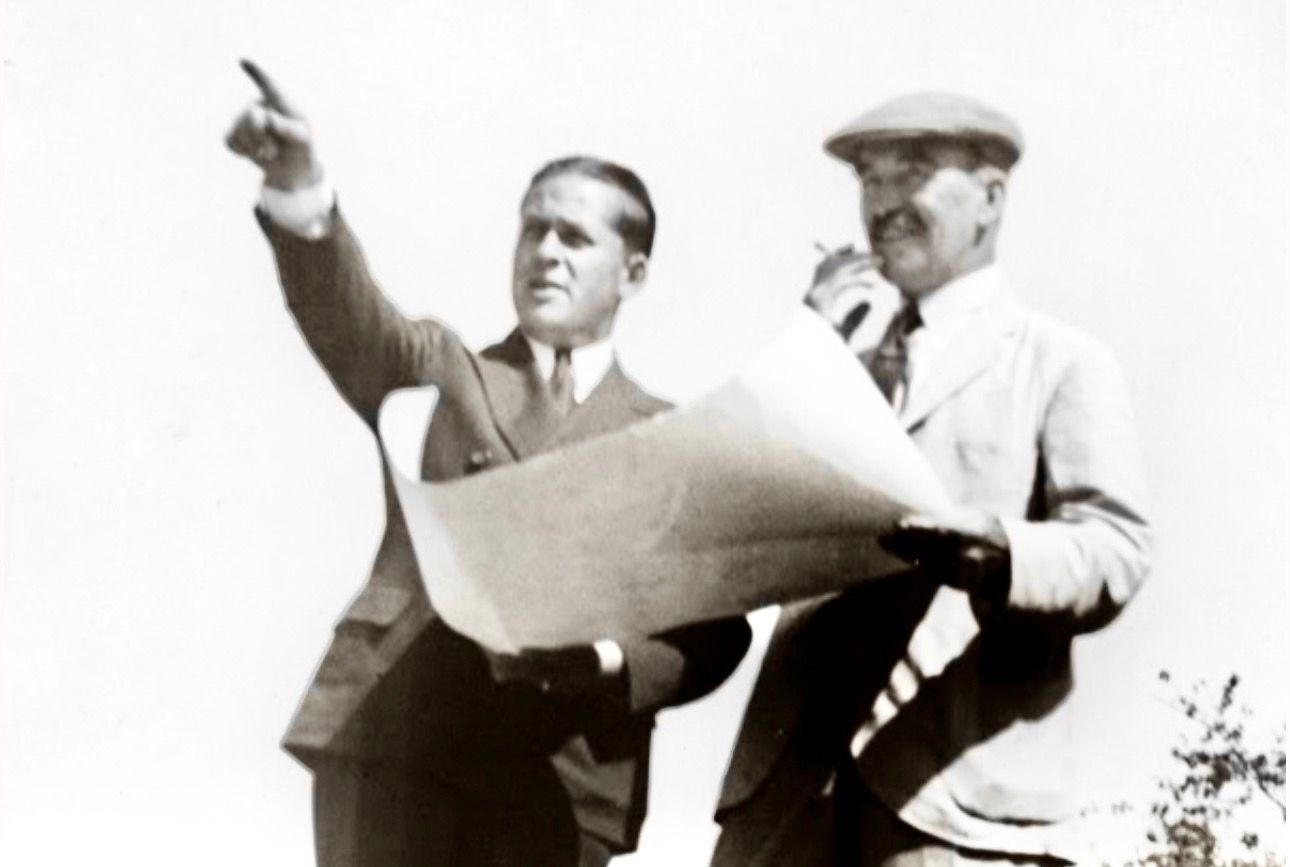
Bob Jones & Alister MacKenzie at ANGC
An Early Story on MacKenzie & Augusta
Dr. Alister MacKenzie, Scottish golf architect, has a plan of course construction that is sound enough in theory, one which is approved by the few outstandingly brilliant players, satisfactory to the dubs, but disliked by the fairly good linksman.
It Is Dr. Mackenzie's theory that a course should be so constructed as to make average, scores quite high with an occasional exceptionally low score.
He believes that it should be all but impossible for an average player to make the ideal course in par. Bogey figures would be easy to make, but not par or sub-par.
His perfect course would contain relatively few bunkers, possibly not more than 200. But the greens would cause the trouble. The high handicap player would bave no trouble in getting near the green, pitching and running well up to the pin, and taking a somewhat easy five.
The low handicap man, however, would have to make a shot of championship caliber to reach home in two, lying close enough to the pin to have even an outside chance for a birdie three.
Dr. Mackenzie recently completed the Augusta National golf links, designed in company with Bobby Jones. This course is Jones' especial pride. The Scottish architect supervised work on the Bayside (N. Y.) golf club course, a public fee establishment.
The designer offers as proof of his contention the situation existing on the Monterey Peninsula. He points out that the average score for tournament play on the Cypress Point course, which he designed, are higher than at Pebble Beach, yet the record is three or four shots lower.
- Stuart Cameron, 1932
Excerpts from Dr. Alister MacKenzie’s article in The American Golfer, 1932 discussing ANGC
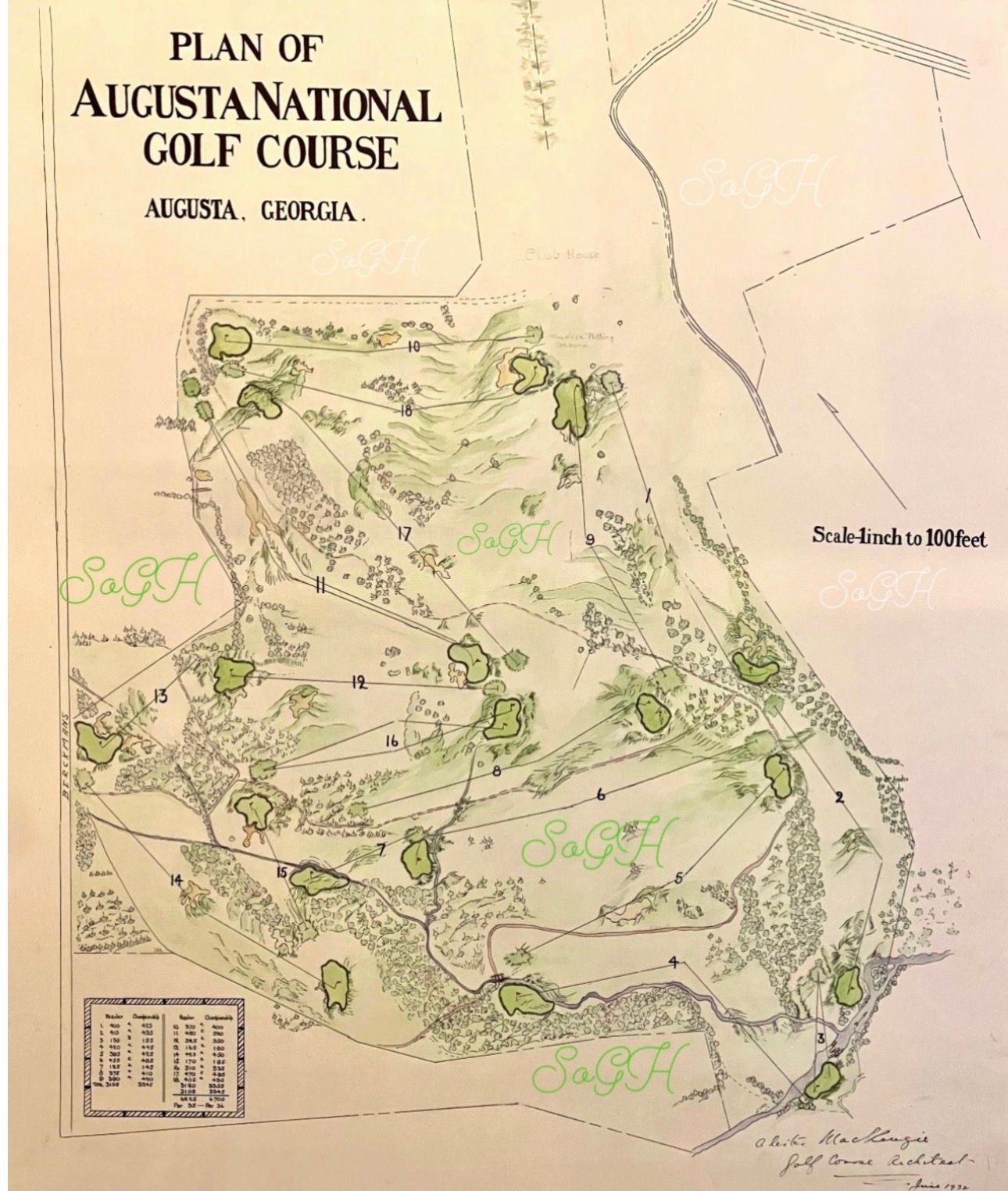
Dr. Alister MacKenzie’s 1932 plan for ANGC
In setting about the task of creating the Augusta National Golf Club course, Mr. Robert T. Jones, Jr. and I have shot at the mark of trying to create the ideal inland course. To accomplish such an aim, one must obviously be equipped with a thorough knowledge of the art of golf course design and be supplied with material with which there is at least a reasonable possibility of attaining that lofty goal.
…
Seeking to create the “ideal” course, the question naturally arises as to just what the “ideal” course should be. Bob and I found ourselves in complete accord on what we conceive to be the essentials of such a course:
1. A really great course must be a constant source of pleasure to the greatest possible number of players.
2. It must require strategy in the playing as well as skill, otherwise it can not continue to hold the golfer’s interest.
3. It must give the average player a fair chance, and at the same time, it must require the utmost from the expert who tries for sub-par scores.
4. All natural beauty should be preserved, natural hazards should be utilized, and artificiality should be minimized.
I want to next say quite frankly, that, if our finished work is favorably received, it will in part be due to the excellent material at our disposal. We had plenty of land, towering pine forests, a large variety of other trees, beautiful shrubbery, streams of water, a mildly rolling terrain of great variety, a rich soil for growing good fairway grass and a naturally beautiful setting from an architectural standpoint.
The Property was originally settled by a Belgian Baron by the name of Berckmans. He was an ardent horticulturalist and in this property he indulged his hobby to the limit of his resources. I don’t suppose the old Baron suspected that golf would some day become a popular sport in America and his property used by the world’s greatest player for a golf course. But if Bob’s great grandfather had foretold to the Baron what was to occur, the Baron could not possibly, in my opinion, have devised a beautification program that would today better serve our purposes.
There are azaleas and camellias in abundance and a great variety of small plants, shrubbery and hedges, and a real cork tree. There are also scores of japonica bushes, that are now really trees — in size. But the most impressive of all is the one-hundred-year-old double row of Magnolia Trees (said to be the finest in the South) that will border the driveway entrance into this “Golfers’ Paradise”.
Now to get back to the golf course. Doubt may be expressed as to the possibility of making a course pleasurable to everyone, but it may be pointed out that the “Old Course” at St. Andrews, Scotland, which Bob likes best of all, very nearly approaches this ideal.
It has been suggested that it is our intention at Augusta to produce copies of the most famous golf holes. Any attempt of this kind could only result in failure. It may be possible to reproduce a famous picture, but the charm of a golf hole may be dependent on a background of sand dunes, trees, or even mountains several miles away. A copy without the proper surroundings might create an unnatural appearance and cause a feeling of irritation, instead of charm. On the other hand, it is well to have a mental picture of the World’s outstanding holes and to use this knowledge in reproducing their finest golfing features, and perhaps even improving on them.
At Augusta we are striving to produce eighteen ideal holes, not copies of classical holes, but embodying their best features, with other features suggested by the nature of the terrain. We hope for accomplishments of such unique character that the holes will be looked upon as classics in themselves.
…
I do not believe the Augusta National will impress anyone as a long course. Although undulating, it is not hilly. There will be no irritating walks from greens to tees, and, moreover, it will be so interesting and free from the annoyance of searching for lost balls, that players will get the impression that it is shorter than it really is.
…
To sum up, I will detail some of the features:
Yardage — The length of the Course from the Regular Markers will be approximately 6,300 yards and from the Championship Markers, 6,700 yards. Both sets of markers will be on the same tees. Par for the Course is 72.
Fairways — The fairways are to be so arranged that every type of player can choose a route from the tees to the fairways, that he should be able to negotiate successfully. The expert, who tries for sub-par scores, will find himself confronted with sporting problems that will require the maximum in strategy as well as skill. In order to ensure exceptionally good turf, equipment for watering the fairways is to be provided.
Greens — The greens will have grass putting surfaces. The majority will be mildly rolling, while a few will be decidedly so. All of the greens will be of generous proportions, the average width being about thirty-two yards and the average depth thirty yards.
Sand Traps — There will be relatively few sand traps, the trees, streams and mildly rolling fairway surfaces supplying natural hazards. There are to be several greens, of unusual design, without a single guarding trap.
Mackenzie on the Strategy of the 12th (used to be the 3rd)
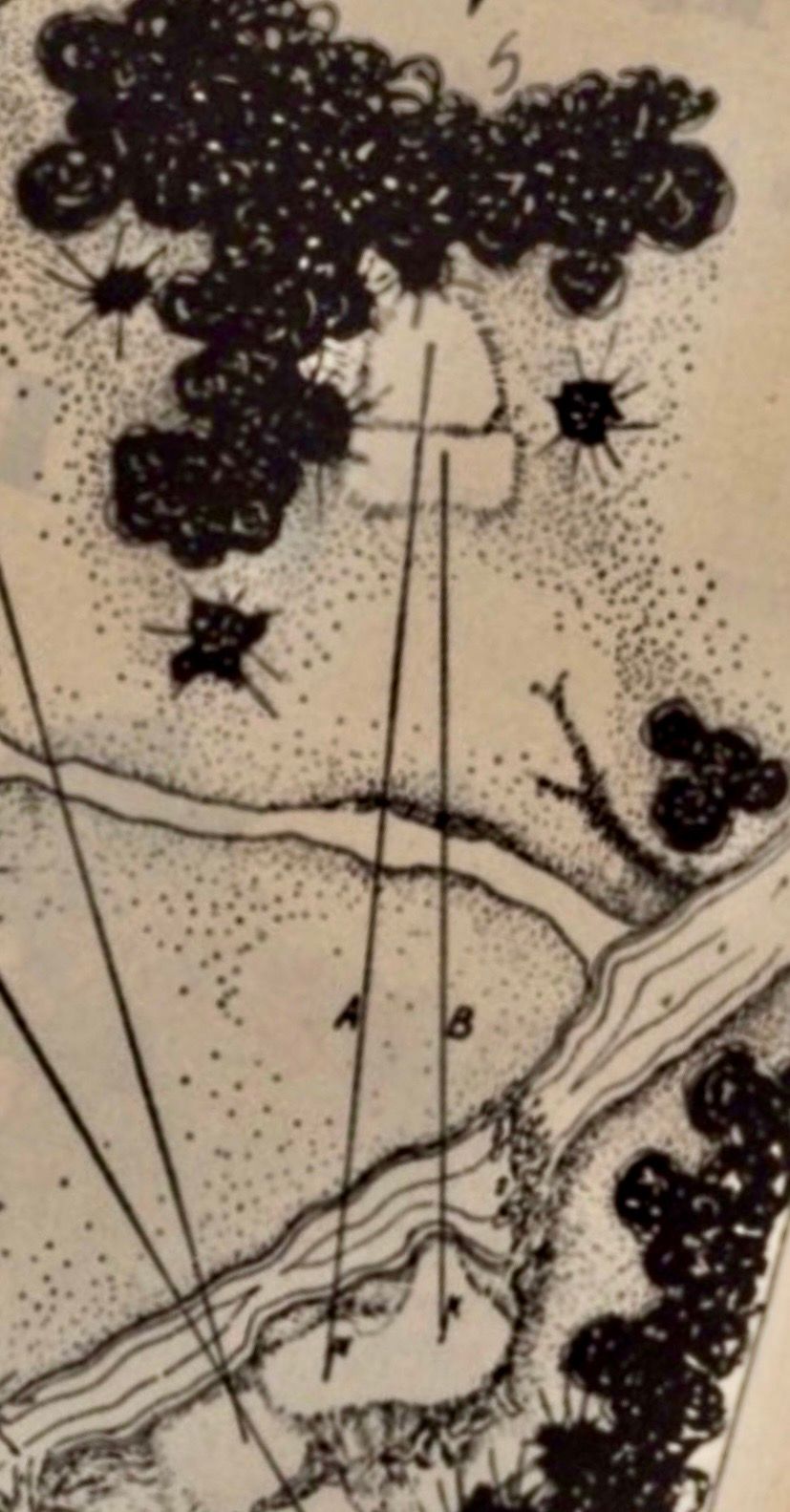
MacKenzie’s 1932 drawing of the 3rd (now the 12th)
12th Hole: “The tee is on high ground from which the green and stream are very visible. There is a beautiful hill slope beyond the green. "A" is the medal position for the pin. The green is very narrow at this spot and is wide when played along "B" route but this involves a long putt across a “A”. It will be noted that stepping stones lead to the green instead of the usual bridge.”
-Dr. Alister Mackenzie
MacKenzie’s on the 13th Hole (then the 4th)
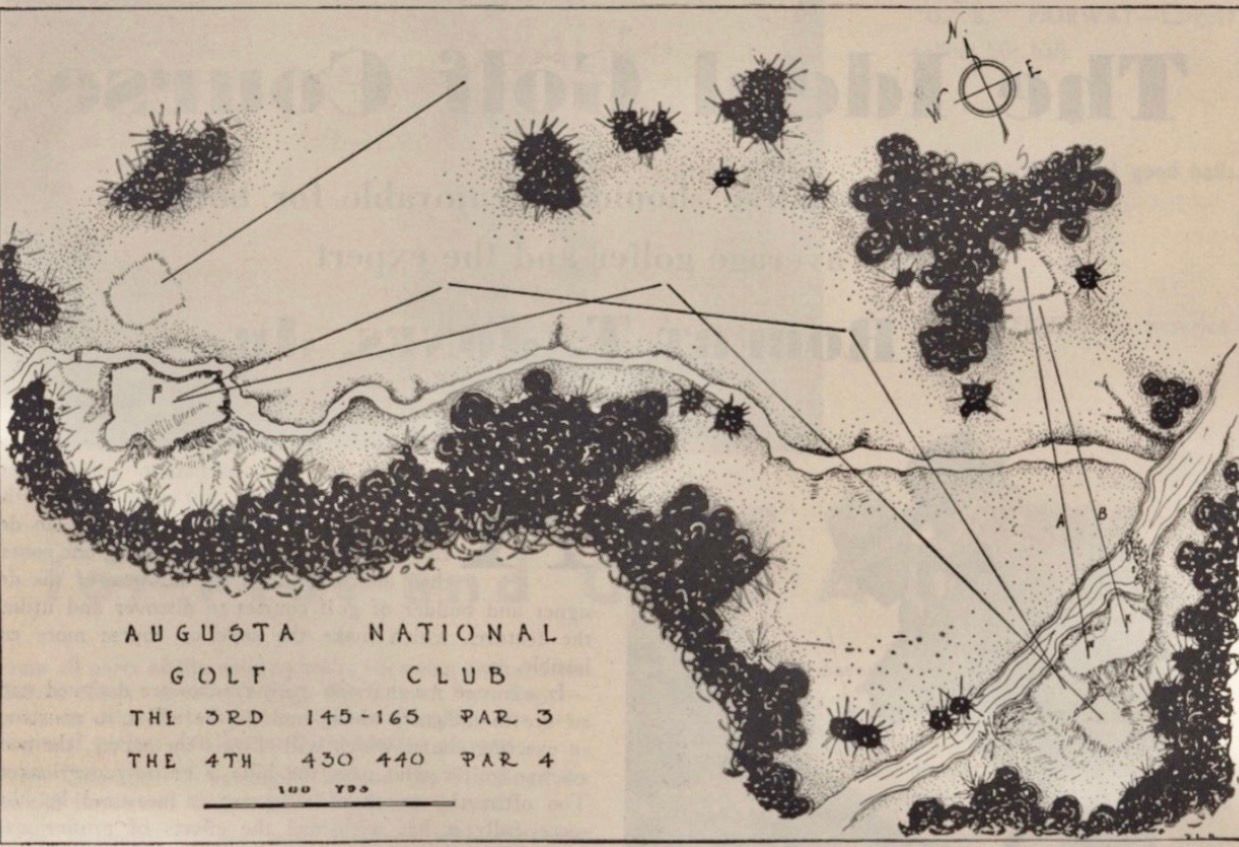
13th Hole: “This is a dog leg hole played diagonally over a stream. The straight and courageous player has a great advantage for his first and second shots. It will be noted there is not a single bunker at either of these holes. There are only twenty-two bunkers on the Augusta National.”
-Dr. Alister MacKenzie
Mackenzie on the 14th Hole (then the 5th)
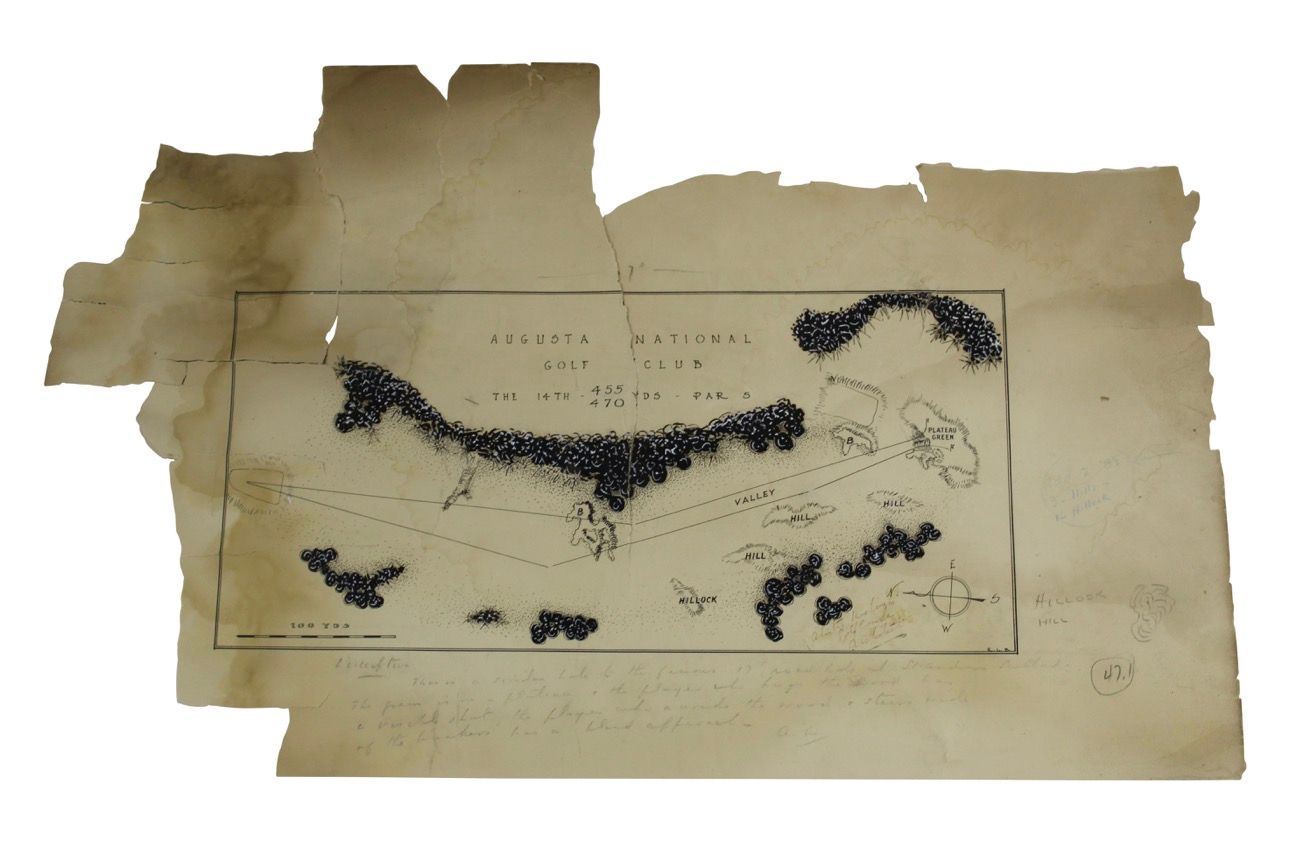
MacKenzie’s actual play for the 14th compliments of the Golf Auction circa 2022.
14th Hole: “This will be a similar type of hole to the famous Seventeenth, the Road Hole at St. Andrews. A group of tress forms a corner of the dog-leg instead of the station master’s garden and the green itself will be situated on a similar plateau to its prototype.”
- Dr Alister MacKenzie
2026 SOCIETY GOLF AUCTION
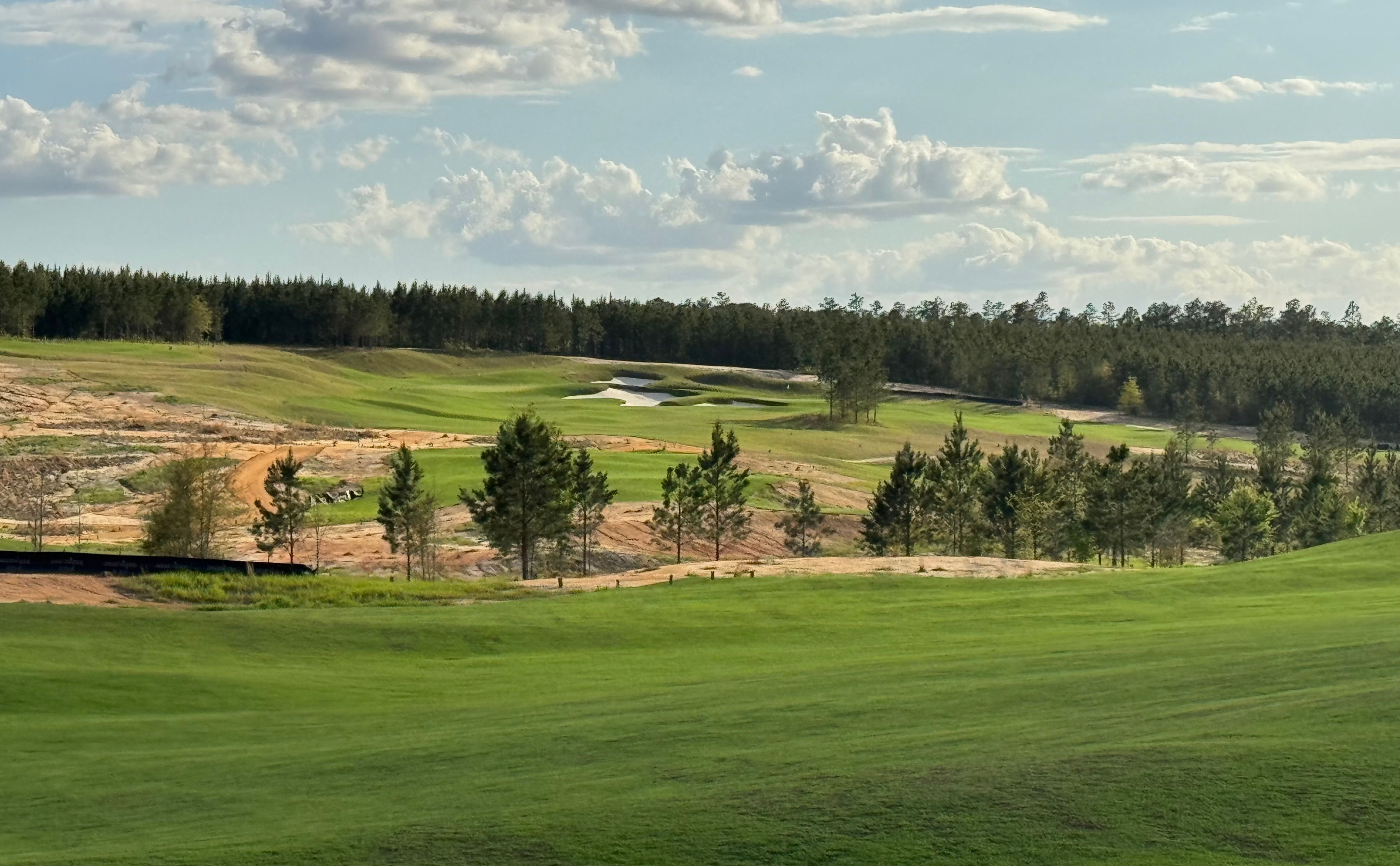
The MacKenzie at the 21 Golf Club
I hope you take the time to bid on the thirty golf course we are auctioning off the week after the Masters Tournament. Our auction will include courses designed by: Dr. Alister MacKenzie, Walter Travis, CB Macdonald, Seth Raynor, Donald Ross, Perry Maxwell and many more!!! Bid and help us fund the research for Stephen Proctor’s next book on Bernard Darwin.
Not interested in golf? We will also be accepting donations.
THANK YOU!
I hope you had a great weekend and enjoyed the 2026 Masters. Thank you for taking the time to read our modest newsletter.