- THE SOCIETY Newsletter
- Posts
- The SOCIETY Newsletter #109

The Enduring Importance of C.B. Macdonald and Seth Raynor in Golf Architecture

Artist rendering of Macdonald and Raynor
In the long story of golf’s evolution, few partnerships have left a deeper, more lasting imprint on the American landscape than CB Macdoanld and Seth Raynor. Together, they didn’t just design golf courses—they established a language of golf architecture that still shapes how the game is played, studied, and restored in America more than a century later.
Their work connected American golf directly to its Old World roots, introduced strategic design to a young sporting nation, and created a template system (sorry Pioppi) that remains foundational today. To understand modern golf architecture, you must first understand Macdonald and Raynor.
⸻
C.B. Macdonald: The Father of American Strategic Golf
Charles Blair Macdonald is often called the Father of American Golf Architecture, and the title is well earned. Born in Canada but attended the University of St Andrews, where he immersed himself in the Scottish game learning from Old Tom Morris himself. When Macdonald returned to the United States he was thoroughly hooked on golf and determined to make his mark.
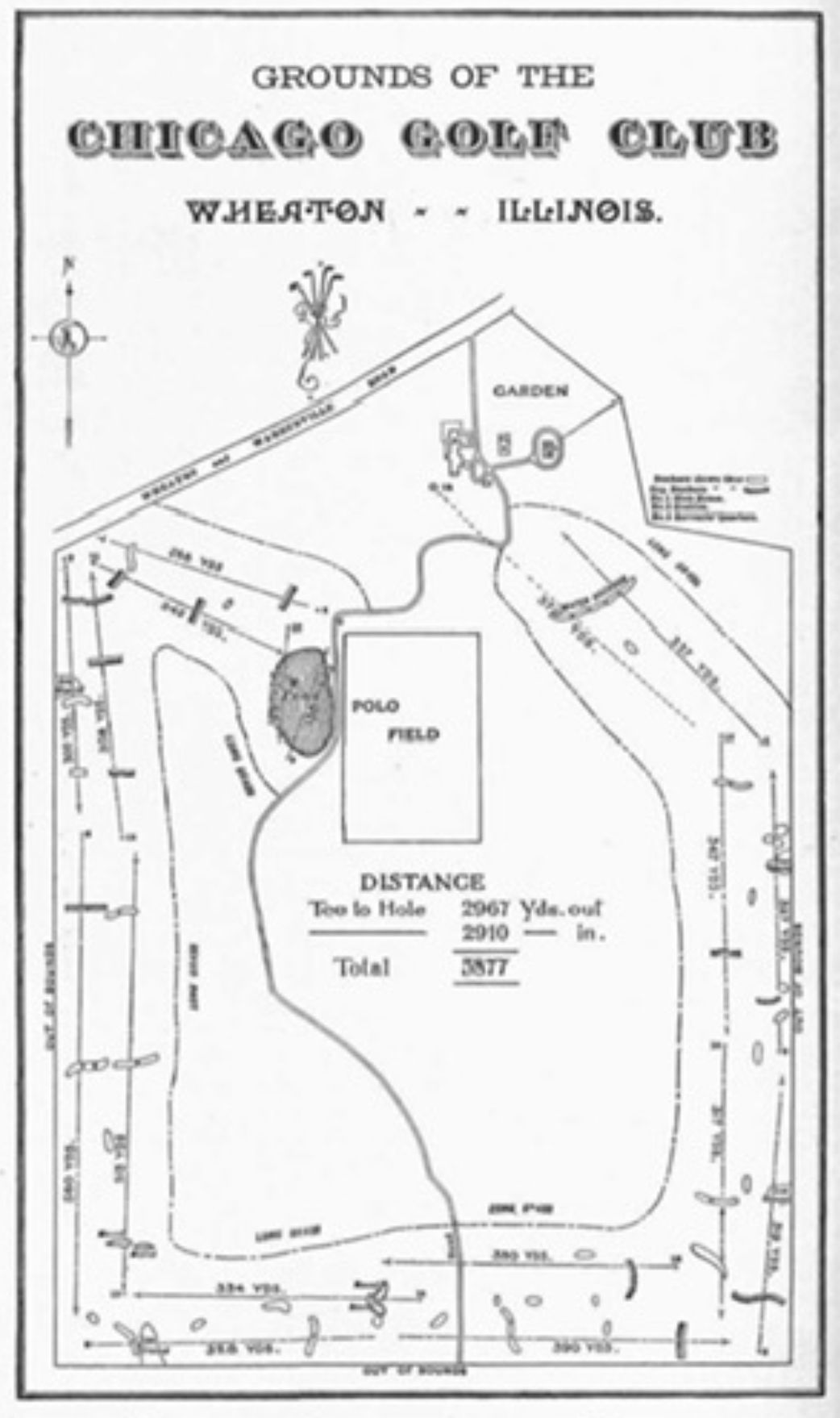
Macdonald’s Victorian Design of Chicago Golf Club
I could go into his three attempts to win the first U.S. Amateur, but that delightful story is for another time. What most people may not recognize is that Macdonald’s first couple of courses that he designed were not strategic but Victorian- the lightening bolt had yet to strike him. The first two designs of the Chicago Golf Club were very much Victorian- fairly simple, straightforward, penal and unimaginative.
Importing the Soul of British Golf
The Lightening Strike we all needed.

MacKenzie’s Map of St Andrews
By the turn of the next century Macdonald had his epiphany - he realized that what he loved so much about St Andrews and other links courses was their strategy- strategy that was missing in America.
Macdonald’s grand idea? He believed the finest holes in the world had already been invented in Scotland and England. Rather than copy them blindly, he studied their underlying principles and reinterpreted them for American landscapes.
From this philosophy emerged his famous “template holes,” (sorry Pioppi and yes I know he called them his “Ideal Holes”) inspired by classics such as:
• The Redan
• The Road Hole
• The Eden
• The Alps
• The Biarritz
• The Short
• The Cape
These were not replicas. They were adaptations—strategic ideas reimagined to fit new terrain and new conditions.
National Golf Links: A Manifesto in Turf

Macdonald’s Map of NGLA
Macdonald’s masterpiece, the National Golf Links of America, served as his architectural thesis. It demonstrated that:
• Golf could be intellectually demanding
• Risk and reward could coexist beautifully
• Width and angles mattered more than narrow corridors
• Good players should be challenged without punishing average ones
This was a radical departure from the “hit it straight, hit it over or suffer” mentality of early American design.
Macdonald’s Larger Legacy
Beyond specific holes, Macdonald gave America:
• A philosophy of design rooted in strategy
• A respect for historic precedent
• A belief that golf architecture is an art form
He made Americans think about why holes worked, not just whether they were difficult.
Without Macdonald, American golf architecture might have remained provincial. With him, it became intellectual, ambitious, and globally relevant.
⸻
Seth Raynor: The Engineer Architect

Seth Raynor
If Macdonald was the philosopher, Seth Raynor was the master builder.
Trained as a civil engineer, Raynor had no formal background in golf when he began working with Macdonald. What he possessed instead was something equally powerful: technical brilliance, organizational discipline, and an eye for scale.
When Macdonald’s health declined, Raynor became the driving force behind the partnership—and eventually its greatest executor.
Turning Ideas into Landscapes

The Cape Hole of NGLA
Raynor transformed Macdonald’s theories into physical reality.
He mastered:
• Massive earthmoving before modern machinery
• Complex drainage systems
• Precise green construction
• Monumental bunkering
• Bold landforms
His courses were feats of engineering as much as design.
Where Macdonald imagined, Raynor executed.
The Raynor Style: Bold, Clear, Timeless

The Biarritz of Fishers Island
Raynor refined the template (sorry Pioppi)concept into something visually and strategically unmistakable.
There is nothing timid in Raynor’s work. It is confident, architectural, and unapologetically bold.
Courses such as Fishers Island, Yale, Camargo, and Shoreacres demonstrate how these Ideal Holes could be adapted endlessly without becoming repetitive.
Each feels unique—yet unmistakably Raynor.
Raynor’s Independent Legacy
After Macdonald’s death, Raynor continued working with many of America’s most prestigious clubs. His influence spread rapidly, and his assistants—most notably Charles Banks—would carry the style forward.
In many ways, Raynor ensured that Macdonald’s philosophy survived long after its creator was gone.
Without Raynor, Macdonald’s ideas might have remained isolated. With Raynor, they became institutionalized.
⸻
The Template: Their Greatest Contribution
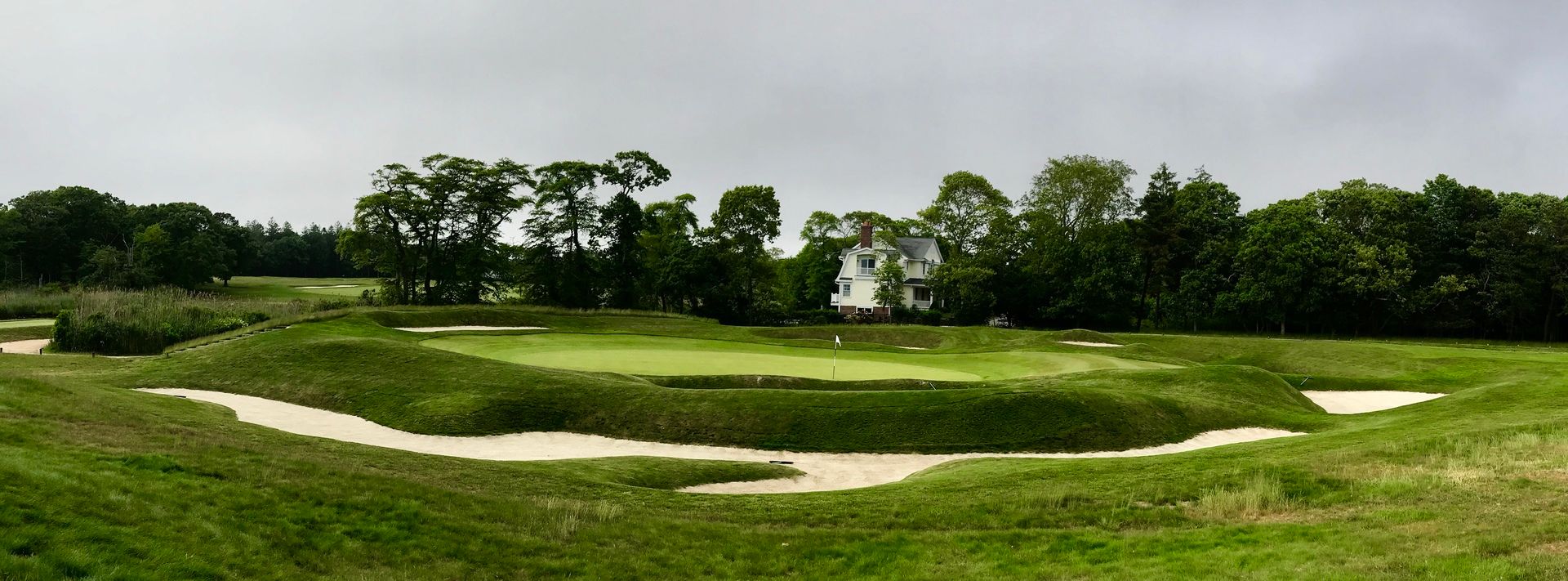
Westhampton’s Punchbowl
Perhaps no single contribution has been more misunderstood—and more influential—than the template hole.
Critics once dismissed it as repetitive. In truth, it is the opposite.
A template is not a copy. It is a strategic framework.
For example:
• A Redan is not “a green sloping front right to back left.” It is a hole that rewards running approaches and thoughtful positioning.
• A Biarritz is not “a green with a swale fronting it.” It is a test of distance control and nerve.
Macdonald and Raynor created a design vocabulary that architects still use today—consciously or not. They designed a path with or without ideal holes that led to the Birth of the Golden Age of Design.
⸻
Why Their Work Matters More Than Ever Today
In the modern era of golf design where we have embraced the ideals of the Golden Age, Macdonald and Raynor feel almost prophetic.
Their designs emphasize:
• Width over confinement
• Angles over straight lines
• Thinking over brute force
• Options over prescriptions
They reward creativity, not conformity.
This is why their courses age so well. As equipment evolves, their strategic foundations remain relevant.
The Restoration Movement

The Lost Seth Raynor
Much of today’s architectural renaissance, especially restoration work centers on rediscovering Macdonald and Raynor principles:
• Reopening corridors
• Rebuilding bold greens
• Restoring bunkering scale
• Reclaiming strategic angles
Their work has become the gold standard for historical integrity.
For stewards of classic golf, Macdonald and Raynor are not just influences, they are benchmarks.
⸻
Architecture as Intellectual Sport
At its best, golf is not just a physical contest. It is a mental dialogue between player and landscape.
Macdonald and Raynor understood this better than anyone.
Every fairway they shaped, every green they contoured, every bunker they placed was a question:
How will you play this?
That question still echoes today—from Long Island to Lake Wales, Florida, from New Haven to the Midwest, from original masterpieces to rediscovered “lost” gems;)
Their work reminds us that great golf architecture is timeless, strategic, and deeply human.
And that is why C.B. Macdonald and Seth Raynor remain, more than a century later, the architects of America’s golfing conscience.
The Lost Seth Raynor

The Lost Seth Raynor
We are currently in negotiations to acquire a lost Seth Raynor course. Our goal will be to fully restore the course to its original design.
When we close on the acquisition, we will offer three levels of membership for those interested in joining a Seth Raynor course with zero waitlist.
Membership Levels
Equity- Own the course with me. Be a major part of restoring a lost Seth Raynor.
Founding: A membership that serves as debt for the club. The debt will be paid back to the member, however it will be paid back without interest.
Traditional: A one time membership fee
In a future SOCIETY Newsletter I will provide a glimpse into the restoration plan.
If you have an interest in being a member or an equity owner, please reach out or stay tuned.
Thank you!
Thank you for taking the time to read our newsletter. If you are a fan of the TalkinGolf History Podcast our next two episodes should be:
Inside The Ben Hogan Company
Interview with Padraig Harrington
