- THE SOCIETY Newsletter
- Posts
- The SOCIETY Newsletter #113

Palmers Grips

Palmer’s legendary grip on the club
Arnold Palmer never told anyone why he did it. That was the best part.
Every morning of a tournament round—long before the galleries arrived and before the dew had burned off the fairways—he’d sit quietly at his locker with a roll of grip tape, a bottle of solvent, and a folded piece of paper pulled from the side pocket of his bag.
On that paper was an outline of his own hand.
He had traced it years earlier, carefully, like a man marking a map. Fingers spread just so. Thumb angled naturally, not forced. The creases of the palm lightly penciled in, showing where pressure should live and where it absolutely should not. It wasn’t superstition. It was self-knowledge.
Palmer would lay the paper flat on the bench, set the grip beside it, and compare. Not measuring in inches or millimeters, but in feel. Did the grip swell where his palm wanted freedom? Did it thin where his fingers needed to talk to the club? Was today a day for firmness under the heel of the hand—or softness, to let the club swing itself?
Then he’d get to work.
Yesterday’s grip came off without ceremony. Solvent splashed, tape wrapped, layers added or removed with the quiet confidence of a man who trusted his hands more than any blueprint. Some days the right hand was built up slightly, matching the way his fingers had curled in the outline. Other days he’d leave it thinner, closer to the tracing, as if reminding himself not to over-control.

Arnold Palmer’s Golf Grip
A slightly thicker right hand on Thursday.
A softer taper on Friday.
Cord under the left thumb on Saturday, smooth rubber everywhere else on Sunday.
If you asked him about it—and a few brave souls did—he’d smile that half-grin and say, “Feels right today.” He never mentioned the paper. Never mentioned the tracing. That was between him and the club.
The equipment reps thought he was crazy. The purists were baffled. Sportswriters tried to explain it with science: humidity, grip pressure, temperature. They were missing the point entirely.
Palmer wasn’t changing grips because the course demanded it.
He was changing grips because he was different every day.
Some mornings he woke up calm, swinging like water rolling downhill. Those days he wanted the club barely there at all—thin grips, soft rubber, something that matched the easy curve of his hand on the paper. Other mornings, especially after a bad round, he wanted resistance. Something to push against. Thicker, firmer, corded—built up just beyond the outline, daring him to be stronger than his doubts.

Palmer’s 1984 irons (from the Golf Auction)
He believed golf was a conversation between your hands and your mind. And like any good conversation, the tone mattered.
By the time he reached the first tee, the club felt inevitable. Not new. Not altered. Just right. As if it had always been that way and you were foolish for imagining otherwise.
Competitors noticed things, though. They noticed how Palmer’s swing never looked rehearsed—how it changed subtly from day to day, round to round, yet always arrived at the ball with conviction. They noticed how he could look loose and ferocious at the same time. Like a man who trusted instincts over instructions.
Late in his career, a young pro finally pressed him on it.
“Mr. Palmer,” he said, “don’t you worry about consistency?”
Palmer folded the paper, slid it back into his bag, wiped his hands with a towel, and looked out over the course.
“Son,” he said, smiling, “the hands tell you who you are today. Best listen to ’em.”
And with that, he walked to the tee—grips fresh, mind clear, playing that day’s round of golf, exactly the way it asked to be played.
Two Arnold Palmer Artifacts
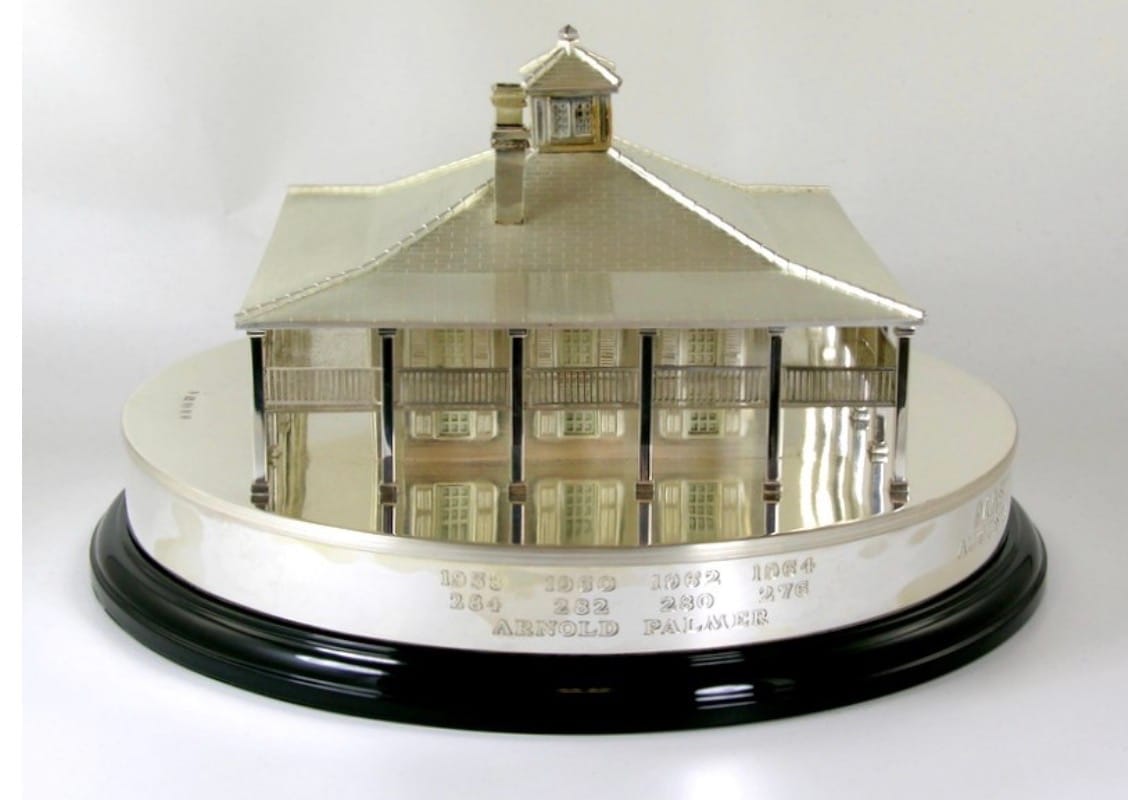
In 2016, Golden Age Golf Auctions offered one of Arnold Palmer’s most remarkable possessions: a sterling silver replica of Augusta National’s iconic clubhouse—the trophy presented to each champion of the Masters.
This particular example was especially intriguing. It was not Palmer’s winner’s trophy, but rather a duplicate that had been commissioned for a museum that ultimately never opened. As a result, it remained one of the few examples of this coveted prize ever to appear on the open market.
When the gavel finally fell in 2016, the piece realized more than $440,000, a staggering sum that reflected both Palmer’s legacy and the near-mythical status of Masters artifacts.
Nearly a decade has passed since that sale. Given the continued growth of the golf memorabilia market—and the extraordinary rarity of these trophies—it is not difficult to imagine that, should another example surface today, it could very well threaten the seven-figure mark.
Arnold Palmer’s Putter

Palmer’s 1964 Masters winning putter
In 2017, Golden Age Golf Auctions offered a remarkable artifact from one of golf’s most beloved champions: Arnold Palmer’s putter from his 1964 Masters victory. The club was far more than a piece of equipment, it was an instrument of one of Palmer’s final major triumphs at Augusta National. By 1964, Palmer had already become the game’s most charismatic figure, and that April he captured his seventh and final major championship, holding off a field that included Jack Nicklaus and Gary Player. The putter in question had been in Palmer’s hands during that historic week, guiding the crucial strokes that sealed another Green Jacket.
For collectors, the significance was profound. Palmer’s 1964 win represented the closing chapter of his major championship career, and the clubs from that victory carry immense historical weight. Few items in golf memorabilia can claim such a direct connection to a defining moment at Augusta National, particularly one tied to Palmer’s enduring legacy and the era when “Arnie’s Army” ruled the fairways. When the putter crossed the auction block, it wasn’t merely a club being sold—it was a tangible piece of Masters history.
When the bidding concluded, the putter realized $96,000, a powerful result that underscored the reverence collectors hold for Palmer and the scarcity of true major-championship artifacts. In a market where provenance and story often define value, few stories resonate more strongly than Arnold Palmer winning at Augusta. The sale served as yet another reminder that the tools of golf’s legends… especially those tied to the Masters carry a magic that collectors are eager to preserve.
SOCIETY GOLF AUCTION
The Society Golf Auction will kick off in April 2026. Here is a preview of some of the amazing golf venues we have secured thus far. I hope you will consider bidding.
• The MacKenzie Course at 21 Golf Club
• Crystal Downs (twosome with me)
• Belleair CC
• Interlachen CC
• The Inverness Club
• Sarabay CC
• Hyannisport Club
• Blue Mound
• Saint Andrew’s Golf Club NY
• Lake Zurich Golf Club
• Black Sheep Golf Club
• Hollywood Golf Club
• Eastward Ho
• Old Barnwell
• Army Navy CC
• Palmetto Club
• Moraine CC
• Prairie Dunes
• Meadowbrook
• Peachtree
• Dismal River
• Everglades (twosome with me)
• Fox Chapel
• Mountain Lake
• The Lido
• Midland Hills
• Country Club of Naples
• A surprise US Open Course
Hope you have a chance to bid on a golf round. Proceeds of this auction will help fund Stephen Proctor’s next book on Bernard Darwin.
Thank you!!!
As always thank you for taking the time to read our newsletter. Just a heads up- we are also working on a small Society of Golf Historians outing at Oak Hill Country Club this Summer. If you have an interest feel free to email me.
