- THE SOCIETY Newsletter
- Posts
- The SOCIETY SPECIAL EDITION

THE SOCIETY — SPECIAL EDITION
Two Auctions. Four Objects. One Immutable Truth: You Can Own a Piece of History.
The coming days present a rare convergence—two auctions, separated by a single week, offering four artifacts that sit at the very center of golf’s material history. These are not curiosities. They are anchors - the kind of objects around which great collections are built, studied, and ultimately remembered.
One auction speaks to power and prestige in the modern professional era.
The other reaches back to golf’s earliest physical form, when the game was still learning how to exist.
Together, they tell the story of golf—from hand-hammered iron to major championship gold.
——
AUCTION I — THE GOLF AUCTION
Closes this Sunday Evening · March 1, 2026
Circa 1930s PGA of America Championship Rodman Wanamaker Trophy (Player Model)

This is a player-issued Wanamaker Trophy, cast in the 1930s, now nearly a century old and one of only eight known examples in existence.
The Wanamaker Trophy is the largest and most imposing prize in major championship golf, conceived by Rodman Wanamaker himself when he personally funded the PGA Championship in 1916. The department-store magnate understood symbolism: if professionals were to be elevated, the trophy had to command the room.

This circa-1930 player model retains every hallmark of the original vision—deep engraving, elaborate vine-and-grape finial, curling handles, and sculptural relief rarely seen in sporting silver. Comparable examples from the Sam Snead Collection realized six-figure prices at Heritage, and those bore additional champion engraving. This example stands on its own—unassigned, untouched by personalization, preserved as an object rather than a narrative overwrite.
Yes, it shows age. A handle break. Subtle settling at the top.
That is not damage so much as it is evidence of a lifetime of use.
Why it anchors a collection:
Because major-championship player trophies almost never trade privately. They live in museums, champion estates, or never leave the vault. Owning one places the collector not adjacent to history—but inside it.
——
THE GOLF AUCTION
Closes this Sunday Evening · March 1, 2026
Rare Tom Stewart R.T.J. Inspected Iron Set (1–9, Mashie Iron substituted for the 3 iron)
To club collectors, Tom Stewart is not a name—it is a benchmark.

Stewart was the cleek maker trusted by Old Tom Morris, James Braid, Francis Ouimet, and Bobby Jones. His pipe stamp alone elevates a club. Add R.T.J. inspection marks, matched set provenance, and personal inspection—and you enter the rarest air in equipment collecting. The initials stamped into each iron head “RTJ” stand for Robert Tyre Jones, Jr.
Why are these irons amongst the most sought after sets in the world of golf antiquities? They are insanely rare. As the mythology goes: Tom Stewart started personally making irons for Bobby Jones in 1926 (this is known). Stewart then used those molds to make this famous RTJ irons. When Jones heard about these sets for sale, he wrote a cease and desist to Tom Stewart in fear of losing his amateur status. Because of this very few irons were made and even fewer full sets were sold.

This set, assembled between 1926 and 1930, reflects the final era of hand-inspected steel craftsmanship. Only approximately ten matched sets are believed to exist. Each head bears the strong R.T.J. stamps, with professional attribution to W. Yeoman of Chicago—adding an American competitive lineage to a Scottish master’s work.
These clubs were tools first—assembled, adjusted, and trusted by players who understood loft by feel, not by number.
Why it anchors a collection:
Because elite golf collections require equipment lineage, not just trophies. This is craftsmanship at its peak—before mass production diluted touch, weight, and intent. This rare set was built upon the molds of Bobby Jones own clubs- this is as close as one can get to owning Bobby Jones golf clubs.
———
AUCTION II — GOLDEN AGE GOLF AUCTIONS
Closes Evening · March 8, 2026
Sam Snead’s 1951 PGA Championship Gold Medal — Oakmont
This medal has been chased for over a decade.

Awarded to Sam Snead after his dominant 7 & 6 victory over Walter Burkemo at Oakmont Country Club, this 14k gold medal represents Snead’s third—and final—PGA Championship win. At 39, he was the oldest champion at the time, conquering Oakmont in match play with authority.
Since leaving Snead’s estate in 2013, the medal resided in a South Korean museum—effectively removed from the market. Its return is not routine. It is a reappearance.

Complete with Snead Family Letter of Authenticity, the medal is pure championship symbolism—compact, dense, and unmistakably earned.
Why it anchors a collection:
Because champion-issued major medals with direct family provenance almost never resurface. This is Snead—not commemorated, not interpreted—but witnessed!
———-
AUCTION II — GOLDEN AGE GOLF AUCTIONS
Closes Evening · March 8, 2026
Circa 1775 Heavy Iron — Original Shaft
Before majors. Before professionals. Before clubs even agreed on rules.

This heavy iron dates to circa 1775, when there were only six known golf societies in the world and the game remained a fiercely local Scottish pursuit. Hand-hammered from wrought iron, the club bears every marker of true 18th-century construction: fibrous metal, black oxidation patina, visible hosel weld, and an original ash shaft so thick it resembles a broom handle.
This is not a “display piece.” It is a survivor.
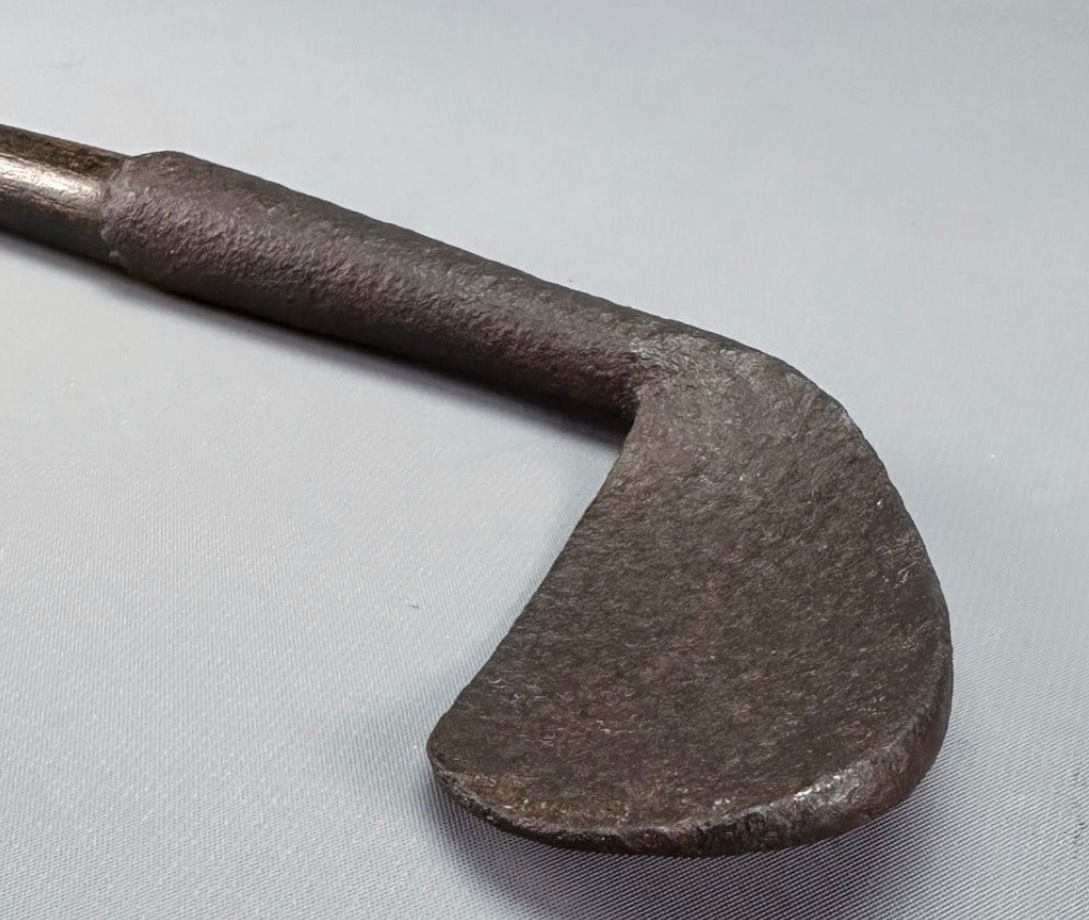
The patina—tight, dark, and undisturbed—is exactly what collectors hope to see and never attempt to improve. The broken shaft pin, the asymmetry, the sheer mass of the head—these are not flaws. They are the fingerprints of the blacksmith.
Why it anchors a collection:
Because nothing grounds a golf collection like pre-industrial reality. Pre-1800 clubs are incredibly rare and they predate the majority of the written word on the game of golf. This isn’t a club- it’s a foundational piece of our treasured golf history.
⸻
FINAL WORD
Great collections are not built by volume.
They are built by gravity.
A 1930’w Wanamaker player trophy.
A Stewart R.T.J. matched set.
A Sam Snead major gold medal.
An 18th-century heavy iron.
Each one pulls everything else toward it.
Each one says the same thing, quietly and confidently:
This is where the story begins.
THANK YOU
This is a special edition to our newsletter. You will still receive our regular newsletter on Tuesday.
